I have been thinking about Karens and their link to everyday racism, surveillance culture and the impact this all has on Black people who already have a history of being surveilled in countries like the United States and South Africa.
The focus on surveillance has been brought on by the increasing revelations about the role of state surveillance in the US and Israel attacks against Iran and the ICE attacks on citizens in the US. I also watched a humorous video of a white American woman showing a bad haircut she had received from a new hair salon but said she did not dare complain about it because she didn’t want to be called Karen. In South Africa, I listened to a radio interview of a South African woman who alleged she had been beaten up after telling a concert goer she saw dumping litter in front of her to not litter. The dialogue before she was attacked is what piqued my interest — she says the black woman she confronted asked her why she was policing them and then while busy with that conversation, another person just started hitting her. Before I go any further, I have to give the disclaimer that violence is never a good way to resolve any conflict and of course littering is wrong. However, this situation presents us with an opportunity to learn and understand each other across race. It is important for us to understand why a Black person called out for something like littering would respond with an accusation that they are being policed or surveilled and why the situation would quickly escalate to violence because it seemed like many people were baffled by the allegation of policing and the escalation from verbal confrontation to violence.
Why are Black people triggered by Karens or Karen- like behaviour?
Social media often frames incidents with individual frames but systems are always at play in interactions between people of different races, especially in countries with a history of racial hierarchies and racial violence. Understanding the historical context of relating with each other across race shows a structural dimension — our encounters are a continuation of systems of surveillance and control.
This is why racial literacy is important because it can help you understand race and racism and its impact on Black people and help you reduce harm, in big and small ways. The woman who asked the Black woman to not litter thought she was acting as a responsible citizen and calling out environmental harm but they didn’t realise bout how their actions could be read as Karen behaviour and responded to violently by those she sought to call out.
Let’s start with the concept of a Karen, a Karen — according to Urban dictionary — is defined as “An ole fashioned busybody who thinks it’s their job to point out their neighour’s transgressions”. It’s a term usually used to describe white middle aged women specifically but it can be used for people of other races and genders when people feel they show signs of surveillance. The term has become code for white women who are seen as entitled, invasive or policing others’ behavior as they often call authorities over perceived minor infringements. For many, Karen behaviour is just mildly annoying behaviour but for black people globally, being surveilled by a “Karen” is triggering because it mirrors centuries of systemic state surveillance, policing, and the controlling of Black bodies and actions.
The policing of Black life has long been institutionalised in formal and informal ways globally but it is especially acute in countries like South Africa and the United States which experienced colonization, slavery, Jim Crow and apartheid. During colonialism in both countries there were all kinds of laws that allowed for blacks to be hunted down like animals and killed. There were also “slave patrols” which was a group of people who monitored and survailed the enslaved, chased them and brought them back into enslavement. In apartheid South Africa, the state implemented a regime of hyper-surveillance over Black people. Pass laws required Black South Africans to carry identification documents at all times, and the Security Branch of the South African Police actively monitored, detained, and harassed those who challenged the system. This made daily ordinary behavior like talking as a group of people or walking through a whites only area alone be seen as a potential threat. This still exists today as people in neighborhood WhatsApp groups flag any Black people walking in former whites only neighborhoods as potential criminals. This level of surveillance continues to create a climate of fear and enforced racial hierarchy at every level of society in ways that we have not even begun to unpack in South Africa, the United States and the world.
In the United States, Black communities have been subject to surveillance from slavery through Jim Crow. Surveillance moved from “slave patrols” hunting down enslaved who escaped, to daily monitoring of black people’s movements during Jim Crow segregation laws to current day police policing movements that heavily harass and monitors black citizens. Black bodies are now currently surveilled via stop and frisk policies across the US which mostly focus on Black and Latino men. State documents which have recently become unclassified have also shown details of how the FBI had a whole programme COINTELPRO to surveil civil rights leaders and activists including Martin Luther King and other leaders like the Black Panthers. Today, surveillance is digital and is done through facial recognition and social media monitoring, which again continues to disproportionately affect Black Americans, Latina and anyone else not white in the era of ICE hunting down those it thinks are undocumented immigrants. All this illustrates that Black Life is seen as inherently suspicious.
Given this history then, when a white individual or white appearing or sounding individual publicly monitors, questions, or reports a Black person — whether in a park, grocery store, or in public transport — it reproduces the dynamics of state surveillance at a micro level for Black people and mimics the patterns of apartheid and Jim Crow state surveillance. One of the most important features of racial surveillance systems is that they are decentralised. Racist state systems did not only rely on formal policing alone. They have historically depended on ordinary white citizens or even those who are not white to extend surveillance of Black people into everyday life. This means that what we now call a “Karen” and Karen behaviour is not operating outside the system — Karen is an embodiment of the system, enacting a historically conditioned role to surveil black bodies. That’s because in racial states, suspicion of Black people was framed as responsible citizenship, encouraged and rewarded. For Black people, encounters with Karens or Karen — like behaviour are not neutral, they carry the weight of history.
A call to the police is not just a complaint — it is a potential escalation to violence
Being questioned in a previously “whites only” space echoes historical restrictions on movement as per apartheid segregation laws and Jim Crow laws
Being watched activates generational memory of control, punishment, and exclusion
Further, Karen behaviour replicates state violence in the following ways:
Presumption of Guilt: Just as the state has historically presumed Black people are suspicious, Karens frequently interpret ordinary behavior as threatening. E.g. Amy Cooper’s 2020 Central Park incident, where she called the police on a Black man who was birdwatching.
The Threat of Authority: By calling the police or security, Karens invoke the same mechanisms the state has historically wielded to control Black life. This is particularly dangerous because the threat is real — law enforcement has historically been complicit in violence against Black people, from lynchings in the US to apartheid-era police brutality.
Public Policing of Space: Surveillance functions as social control. Being filmed, scolded, or accused in public disciplines Black behavior in real time. It signals that Black presence is only acceptable under white scrutiny, echoing the pass laws, Jim Crow laws and policing of Black South Africans and African Americans who dared occupy “white spaces.”
The repeated experience of being surveilled, whether by neighbors, colleagues, or strangers, activates historical trauma. Psychologists refer to this as racialised hypervigilance, a stress response shaped by a generational memory of oppression. The anxiety and caution Black people feel in spaces where they are being observed are deeply rooted in histories of criminalisation and punishment for simply existing in public.
Encounters with Karens are more than awkward social incidents, they are flashpoints in a long continuum of racialised surveillance. For Black people, they echo the systemic monitoring of Black bodies under slavery, Jim Crow, Apartheid, COINTELPRO, Security Branch surveillance and apartheid pass laws. Recognising this link helps society understand that these seemingly trivial interactions are not just social faux pas, they are expressions of a broader racialised power structures.
A Karen is not merely a person, she is a microcosm of centuries of surveillance, suspicion, and control imposed on Black bodies. This is why Black people’s responses to what they deem as Karen behaviour may seem disproportionate to the individual moment or incident. Karens trigger post traumatic stress responses based on fear and profound psychological stress.
“Karen” incidents replicate the same logic of suspicion and control historically used by the state. They invoke real threats of violence or legal consequences, even when framed as minor social interactions. Both micro (everyday encounters) and macro (state surveillance) forms of monitoring produce psychological trauma.
The persistent surveillance of Black people in everyday normal life activities extends to the workplace too. Black people, especially black women, experience high surveillance in the workplace. This surveillance has an emotional toll on those being observed. It produces stress, hypervigilance, and emotional labour. Black women often report feeling “on display,” needing to manage not just work tasks, but how they are perceived by supervisors and colleagues. The psychological impact can lead to burnout, anxiety, and diminished workplace satisfaction.
The graphic below most demonstrates how Black Women are surveilled in the workplace.
Press enter or click to view image in full size
Avoiding “Karen behaviour” is not just about being nicer or more self-aware in isolated moments, it requires actively unlearning the social role that many white people have been historically and culturally positioned to play: watcher, evaluator, enforcer. It is not about performing politeness, it is about refusing a historical role and letting go of the need to monitor, resisting the urge to control, choosing relation over suspicion
Here’s what you can do to shift from seeking surveillance to seeking relation with others.
- Interrupt the Reflex to Police
Before questioning, confronting, or reporting a Black person, pause and ask if you would notice or question this if the person were white? Also check if there is actual harm happening, or you are reacting to discomfort? Ask further, what assumption am I making about this person? This disrupts the racial hierarchy logic of Black presence means suspicion and needs action from me. - De-center Yourself as Authority
“Karen behaviour” often rests on an unspoken assumption: I have the right to intervene here.
Become a Medium member
To counter this, recognize that not every space needs your regulation and let go of the impulse to “manage” shared environments. Remember that not everything requires your interpretation or control.
- Stop Escalating to Institutions
Calling security, HR or the police is not neutral, it activates systems with histories of harming Black people. Before escalating, ask yourself if intervening is truly necessary and what disproportionate harm report can cause? In most cases, the safest and most just action is non-escalation. - Shift from Suspicion to Curiosity (Without Intrusion)
Curiosity does not mean interrogation, instead of wondering if people belong here and what they are doing in a space, rather focus on your own business when no harm is present and allow people to exist without explanation. Respect is often expressed through non-interference, not engagement. - Learn the History You Are Stepping Into
Understanding the historical role of white citizen surveillance changes how you act so it’s important to be self — aware.
Recognise that questioning Black presence echoes pass laws, segregation, and policing and reporting “suspicious” behavior has historically led to violence.
Your actions are never just individual, they are historically loaded and awareness is your responsibility.
- Reflect on Control and Discomfort
Often, “Karen behaviour” is about managing anxiety through control so ask yourself the following before acting.
Why does this situation make me uncomfortable? Why do I feel the need to act? What am I trying to control?
- In Workplaces — Stop Participating in Informal Surveillance
Don’t over-report Black colleagues for tone or behavior
Don’t label assertiveness as aggression
Don’t monitor who is “fitting in” culturally
Anti-racist practice is often about being self aware and practicing restraint
Don’t intervene unnecessarily
Don’t question unnecessarily
Don’t escalate unnecessarily
Let Black people exist without being watched, interpreted, or managed.
Are you enjoying these articles and want to support me to write more — buy me a coffee here: https://pay.yoco.com/r/mz1XrL
Are you interested in learning and unlearning more about surveillance and its impact on you in life and the workplace, join my courses, see info below ?
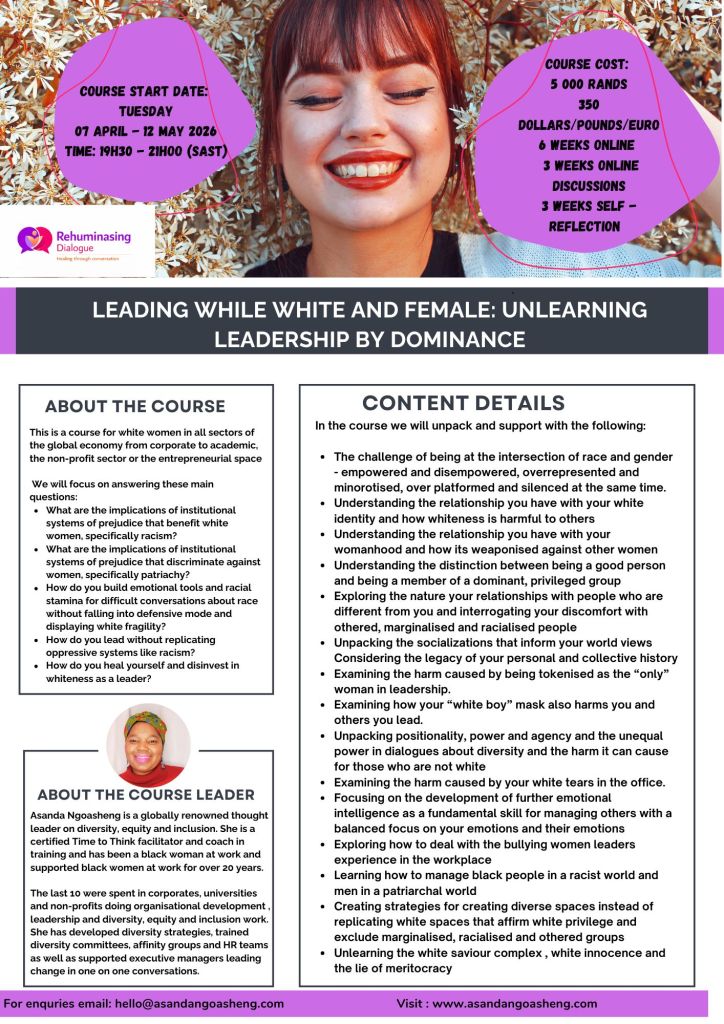
The Leading while White and Female, Unlearning Domination course is for white women dealing with sexism in the workplace whilst trying to understand the impact of their own whiteness on those they lead.See poster above for course details and link to register here: https://forms.gle/Ti7ee86v2M3HFSXk7
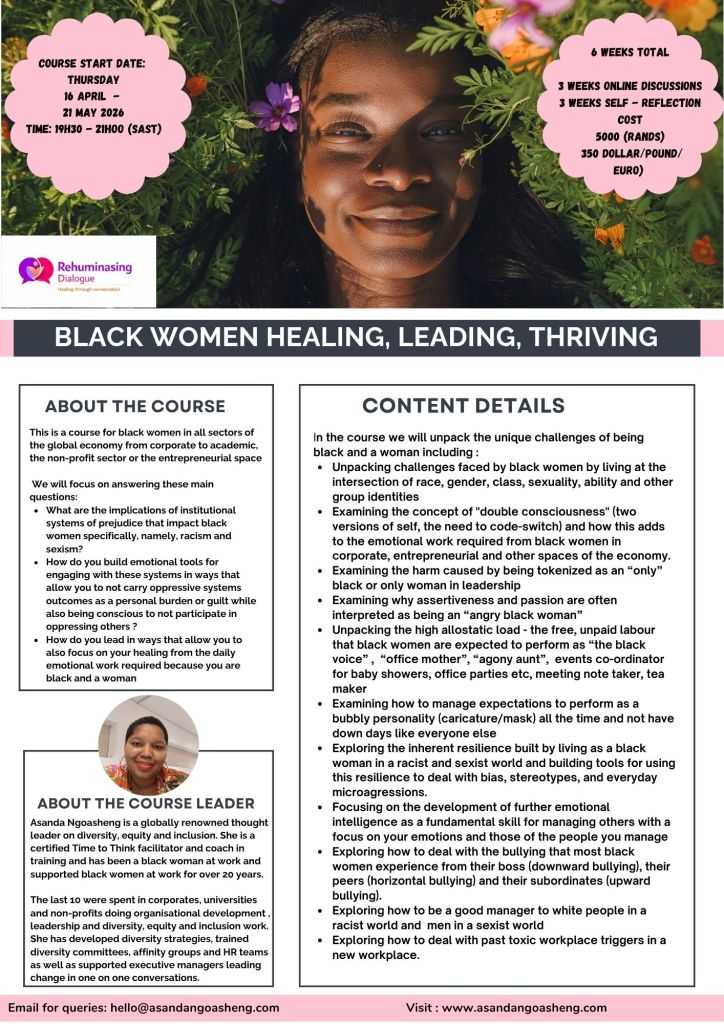
The Black Women Healing, Leading and Thriving course is for Black Women who are dealing with being black and female in the workplace facing racism and sexism.See poster above for course details and link to register here: https://forms.gle/ZBtDFeNmXanPNKYq7
The Black Women Healing course is for all women who are not white !
Discover more from asanda ngoasheng
Subscribe to get the latest posts sent to your email.

You must be logged in to post a comment.