

Last week, I broke down the link between Karen behaviour and its link to everyday racism and Black people’s surveillance in racialised states like South Africa and the United States. If you missed it, check it out here. This week, I continue the conversation by tackling the link between girls’ schools, perfectionism and internal surveillance. Here, I am specifically focused on the kind of perfectionism that is mostly cultivated by girl’s schools. While girls’ schools are critical spaces of empowerment in societies where girls are still marginalised, they can also be sites where gendered expectations are intensified and refined.
If you want to fuel my writing and show your appreciation — buy me coffee here: https://pay.yoco.com/r/mz1XrL
A little personal history before I go into the topic, I spent most of my school life in a former whites only girls school in South Africa. This was right in the middle of South Africa’s transition from apartheid to democracy and all its freedoms. I started at the school in 1993, so I was effectively there from the last year of apartheid and the first year of democracy. I lived through both a dying and a developing political and social system. Before attending this school, I had attended two co-ed schools in a blacks only township, a junior primary and a different senior primary school. Being a black girl at a whites only girls school in the transition from apartheid was a unique experience that taught me a lot about social systems, society and socialisation. There were so many different things to learn and get used to about not only being at a white majority school from being at an ONLY black school but also being at a girls ONLY school from being in school with boys before that.
When I entered the school, I had already been top of my whole grade in Grade 4 and I was consistently in the Top 3 academically at my old schools. So when I arrived, excellence was already embedded in my DNA. As any teacher’s child would attest, failure was not an option and only the best marks and best behaviour was expected of me, so I was already a “good girl” and one of the best performing when I switched schools. Regardless of being familiar with excellence, I was not ready for how excellence was framed at my new girls school.
The school bred excellence, like many girls schools including those I ended up doing Diversity, Equity and Inclusion work in as an adult. My school was an inspiring environment with an extraordinary ecosystem where we were groomed to be future leaders, top achievers, public speakers and assured that we could be anything we put our minds to. Ambition and excellence were expected and we were made to feel invincible and ready to lead the world as an army of girls bred by the best for the best positions in a changing society. As a girl already coming from a culture of excellence, I thrived and excelled. However, excellence also came with a lot of pressure and expectations of perfectionism.
Life at school was a permanent high-performance competition where you were not only expected to excel in academics but you also had to chase sports awards and colours. If you achieved extraordianry things and represented the region, the province or the country, you could wear a blazer with a special braid or a completely different colour blazer that ensured YOU stood out from all the other girls. In this environment, achievement was not what you did, it was a whole identity. Girls competed on academic results, leadership roles, sports leadership, cultural participation and social conduct. These achievements were all woven into what it means to be a “good girl.”
The epitome of the “good girl” — the Head Girl was who we all aspired to be. The ladder to Head Girl started with class rep, academic leadership and sports leadership. Everyone was encouraged to emulate the Head Girl and anything less than their award collecting behaviour was discouraged. You had to be articulate, composed, responsible and capable to be trusted by the schools’ authority and your peers. You had to be perfect, to be deemed worthy of the title of Head Girl or a prefect or even a class rep so we all were encouraged to seek a high level of perfection. The criteria for Head Girl involved assessments of your ability to control your emotions, your behaviour and ability to stick to strict moral codes of correctness which required high levels of self-discipline. In these environments, anger and protest were not tolerated, everything was softened into diplomacy and conflict was to be avoided at all costs. Although vulnerability was allowed, it was only managed vulnerability that was allowed, not the kind where your emotions are all over the place and you are crying uncontrollably or angry. Failure was a swear word, something that you must overcome quickly and quietly. Those who failed were often shunned out of freindship groups, rejected from social activities and left to deal with their shame silently and in isolation. As a result, over time, excellence stopped being something you did, it became who you must be.
Girls were afraid to be wrong, afraid to make any kind of mistakes as mistakes had a high cost. Anxiety was high and beneath the ambition and confidence of many girls was chronic anxiety. Tema Okun argues that perfectionism is part of white supremacy culture where it’s not just about doing things well, it is a cultural pattern that shapes how value, safety and belonging are distributed. This is always done in ways that re-inforce control, exclusion and harm. For girls of all races, perfectionism is harmful and can lead to chronic exhaustion and anxiety. For Black girls, it can lead to even higher self surveilance because for those who are navigating racialised and gendered stereotypes, overperforming becomes the norm and an entry to belonging. Black girls are already at high risk of exclusion because they are Black and girls. In environments of high perfectionism, where the cost of exclusion is already high for anyone who fails, Black girls have to overperform in order to be seen as credible and worthy of belonging in the school.
Left unprocessed, these perfectionist and high performing girls become anxious women. The desire to be chosen as a Head Girl or prefect only intensifies when girls become women and join the workplace. It leads to what has been colloquially called Head Girl Syndrome. This is a phenomenon that many high-achieving women are trapped in where they tie their self-worth to performance and external validation. Many high achieving women, despite race, struggle with Head Girl Syndrome. Any performance lower than their high expectations becomes seen as under achievement. There is a chronic pressure to be composed, capable, and in control at all times, even when the environment does not allow such composure and in fact demands anger and protest. Head Girl Syndrome makes it difficult to express need, vulnerability, and uncertainty. Here knowledge and intelligence are safety blankets worn with pride and emotions and emotional expressions are shunned. Women seeking Head Girl status feel responsible, not just for themselves but also for other’s wellbeing. If one is already a first born in their family, this responsibility is amplified further in ways that make Head Girls feel like they are responsible for the world.
Most women who display Head Girl Syndrome symptoms are leaders, professionals, activists, and changemakers. They excel in life but their success is frequently underpinned by an internal economy of pressure, fear, and self-surveillance. As a result, emotional breakdowns are a near and real fear because of the underlying fear of failure. While there is success, it operates in a fragile system because any setback that feels like failure to them can lead to a monumental nervous breakdown. This has seen many young, successful and especially Black women land up in many mental hospitals due to a nervous breakdown.
Why is the internal system of a Head Girl fragile?
It is fragile because in the system of perfectionism, mistakes are not allowed, they are heavily penalised. Instead of fostering a culture of accountability and repair, the system creates a fear of being blamed, fear of feedback, fear of being seen making errors. This is counterproductive because learning and growth require mistakes. In organisations where perfectionism is encouraged, people hide their mistakes and this undermines any culture of learning that could develop. In such environments achievements are quickly dismissed and new achievements sought without acknowledging the last accolade. Effort is therefore undervalued and only perfect outcomes are recorded, which again means organisations fail to learn and understand the formulas of their own success, which makes it difficult to train future employees on how healthy forms of success are cultivated in the organisation. Ultimately, this leads to burnout and low staff morale.
Perfectionism is linked to surveillance because to be perfect one has to constantly monitor themselves, their behaviour and self correct. While self awareness and self — correction are critical for growth and development, perfection does not lead to healthy growth. It leads to a self critical, self punishing habit that erodes self confidence and self worth. Head Girls constantly burn out because they think rest has to be earned. Boundaries are also low so it becomes difficult to say no to people and activities no matter how tired or low in energy Head Girls are. Head Girl’s entire identity becomes tied to performance, so you don’t have inherent value simply because you are a human existing on earth, you only have value when you are productive. This is why any period of unemployment or lulls in entrepreneurship are soul crushing to Head Girls.
This is how perfectionism is tied to white supremacy culture and systems. The system no longer has to surveil you as you will surveil and punish yourself. Black Women especially discipline themselves harshly even in the absence of external enforcement of codes of belonging and exclusion.
The ultimate trap for Head Girls is that the more capable and successful they are, the less room they feel they have to fall apart. The more others rely on them as a Head Girl, the harder it becomes to admit when they are struggling. While perfectionism helps Head Girls succeed, it also isolates them from community, support and care, especially when they need it most.
The whole point of this conversation and analysis is not about whether girls schools should exist in 2026, they should and are powerful agents of change. Its also not to argue that high achievement is only possible through harm, it’s about how we can redefine the source of high achievement so that people can grow and achieve through healthy rather than harmful ways. The internal infrastructure and motivation for success needs to be healthy for sustained success. Many high-achieving women carry invisible scripts from childhood that have not been examined or processed. They are still seeking the praise they once received as girls for being “so mature ” , “so responsible” , “so capable”, “ so dependable”. Head Girl Syndrome is not about leadership itself, it’s about the high cost of this leadership framework when it is built on perfectionism and conditional self — worth and self — monitoring. My argument is that we can build new frameworks for success, where women don’t have to break themselves to prove their worth. When women already have Head Girl Syndrome, workplace surveillance can tip them over the edge and lead to mental breakdowns. This is because this surveillance connects with an old script that I must perform correctly to be safe, valued, and beyond reproach.
Perfectionism and Head Girl Syndrome can be unlearnt, starting with the following steps. Let us teach ourselves and our girls that:
- Rest is not a reward, but a right
- Leadership also includes asking for help
- Failure is a critical step in learning
- Emotions and emotional expression are a form of intelligence, not a weakness
- Worth is inherent — you are born worthy, you don’t have to earn it through high performance
Head Girls need to start to separate their identity from their output — so what you do is not who you are — you are somebody even when you do nothing or are unemployed or are in between careers. Anger is a valid and healthy emotion that needs self — awareness not suppression. Lastly, asking for help is not failure, it is what any normal human being living in community and society does and should be able to do.
Did this resonate with you? Would you like to work towards unlearning your Head Girl Syndrome?
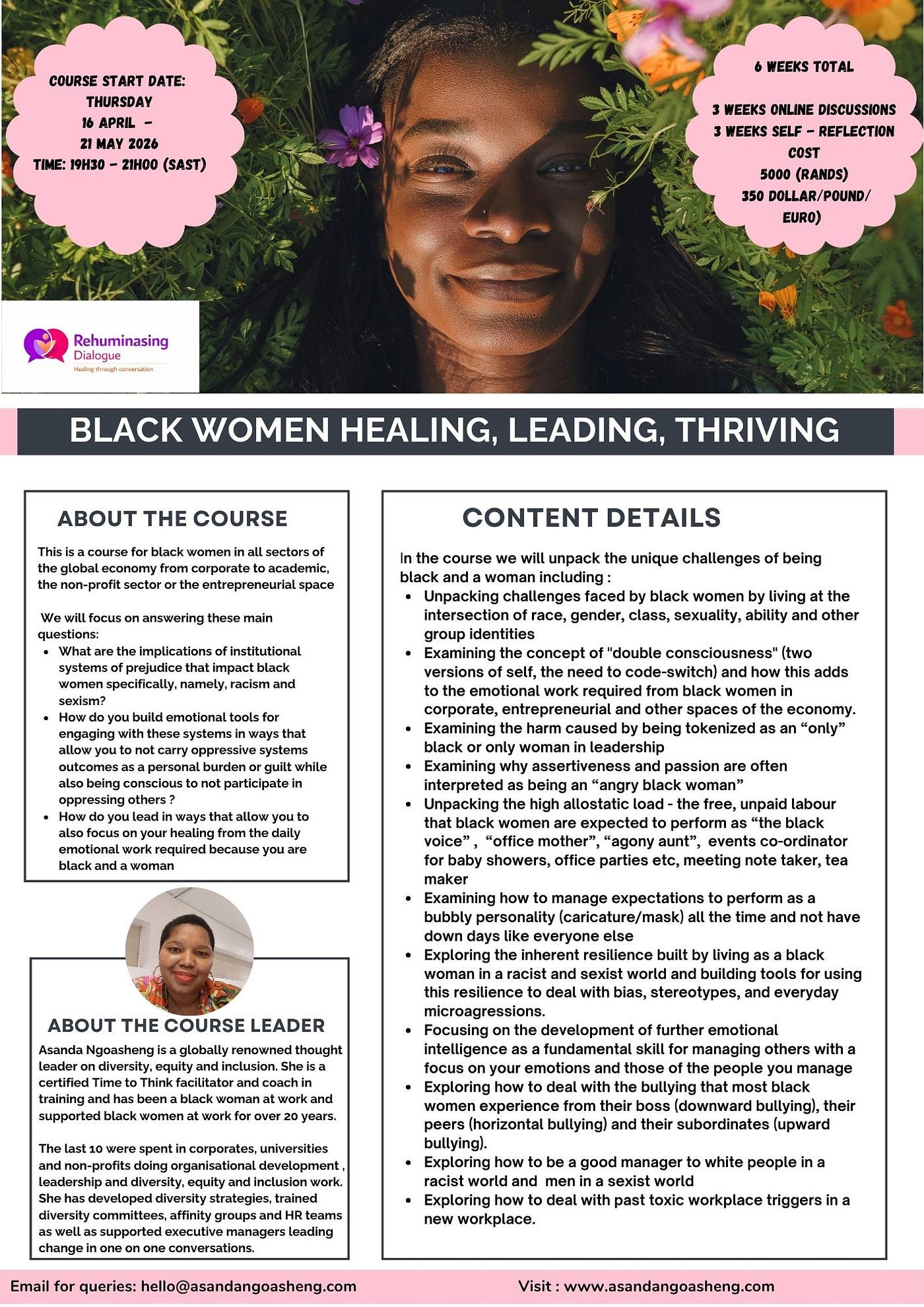
Check out my courses starting in April for Black Women and White Women.
Black Women Healing, Leading and Thriving Course Registration Link
Leading While White and Female Course Registration Link

Discover more from asanda ngoasheng
Subscribe to get the latest posts sent to your email.

You must be logged in to post a comment.